



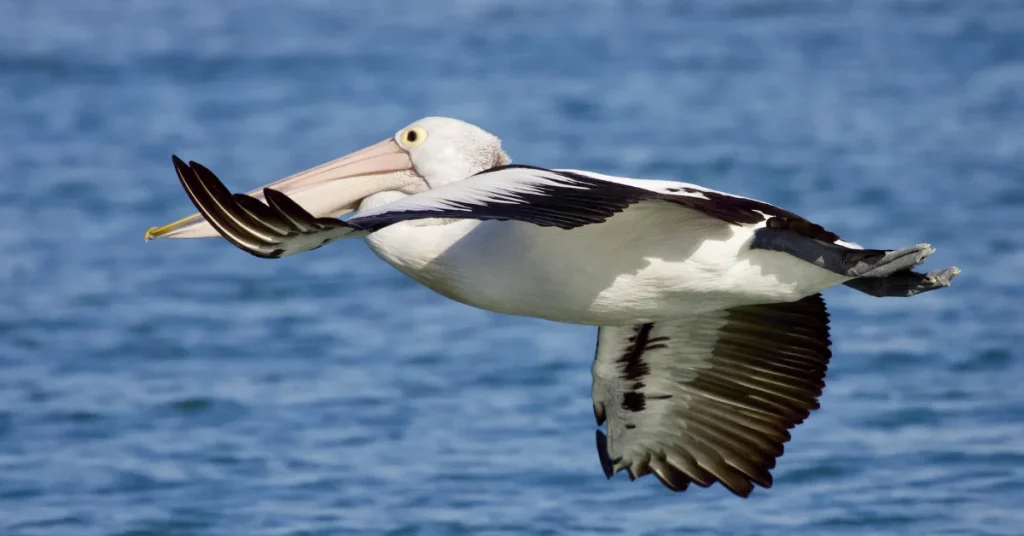
Australian pelicans are a familiar sight along the Brisbane River in Kurilpa, where they can be seen roosting on river structures and pontoon struts for much of the year. The large waterbirds drift with the tides, search the river for fish, and occasionally circle overhead, making them a distinctive part of the inner-city river landscape.
Read: Resilient Kurilpa Leads New Push to Strengthen Flood Readiness in Brisbane’s Inner West
A giant bird on Kurilpa’s riverfront
Few birds are as instantly recognisable as the Australian pelican. With its predominantly white body, black wings and enormous bill, the Australian pelican, Pelecanus conspicillatus, is one of Australia’s largest waterbirds. Its bill measures about 40 to 50 centimetres and includes the large pouch that gives the species its distinctive appearance.

The Brisbane River provides long stretches of open water that pelicans use to take off, land and move through the river environment. Around Kurilpa, they can be seen floating with the rising and ebbing tides or resting on suitable structures along the water.
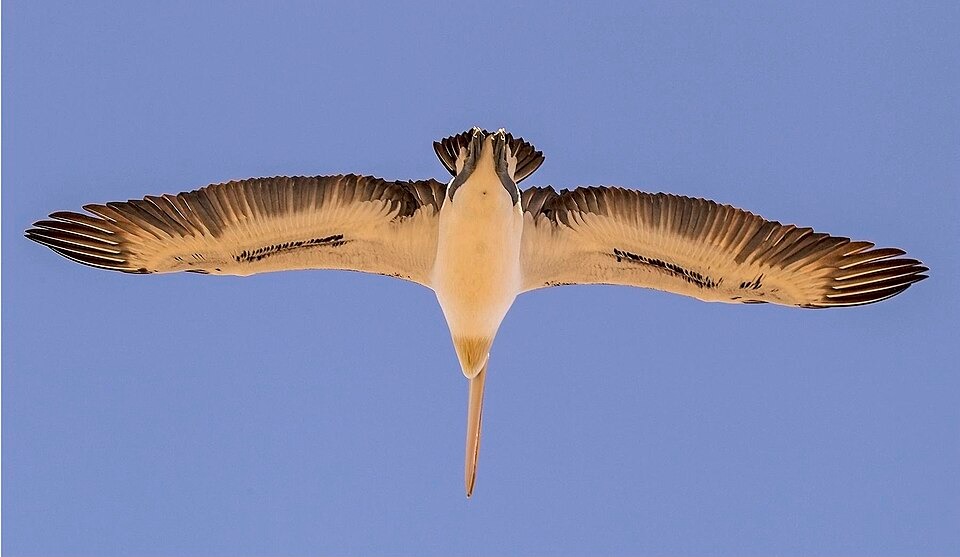
Sometimes, the birds take to the sky. A pelican circling above Kurilpa’s rooftops and riverfront can appear almost prehistoric against the surrounding bridges and buildings. The species is an accomplished soarer, using thermals to gain altitude and travel long distances with relatively little effort.

Their feeding behaviour is equally impressive. Australian pelicans may feed alone, but they also cooperate in groups, driving fish into concentrated areas before catching them with their bills.

For people passing along Kurilpa’s riverfront, these behaviours can turn an ordinary walk beside the Brisbane River into a chance encounter with one of Australia’s most distinctive native birds.
Pelicans cast in metal
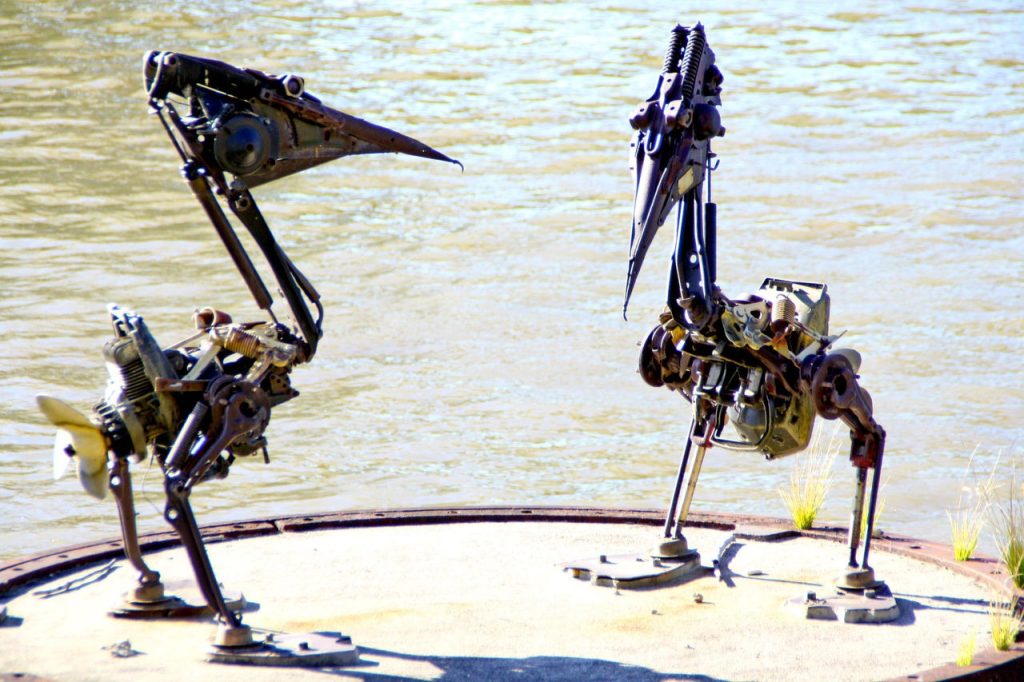
The birds have also inspired a permanent piece of public art further along the Brisbane River. Christopher Trotter’s Biomechanical Pelicans were installed in 1995 on a Brisbane River pylon near the Captain Cook Bridge. The work was Trotter’s second public commission and an early expression of his interest in environmental themes and recycling.


The sculptures were made using found metal and a concrete pedestal. Trotter has since developed sustainability and recycled materials into an important part of his artistic practice. Trotter said the pelicans reference a time when waterways were healthy, while the use of recycled materials reflects his interest in encouraging creative solutions for future generations.
The sculptures offer a striking counterpart to the living birds that continue to use the river. The sculptures are permanent artworks fashioned from found metal. The living birds, meanwhile, can be seen roosting on pontoons, drifting with the tides and searching the river for fish.
The connection between the living birds and Trotter’s sculptures also reflects the broader relationship between Brisbane and its river. Australian pelicans are highly mobile, moving in response to changing water and food conditions across the continent.
When suitable inland water conditions develop after substantial rainfall and flooding, pelicans may gather in large numbers and breed. The species can travel vast distances, linking the waterways of coastal cities with temporary inland wetlands and floodplains.
Read: Highgate Hill Riverfront Development, to Impact Kurilpa Garden, Divides Community
For Kurilpa, though, the pelican’s presence is much closer to home. The next time one appears on a pontoon strut or drifts quietly along the Brisbane River, it may be easy to overlook amid the activity of the inner city. Yet these enormous waterbirds remain a distinctive part of the river landscape, sharing the water with the people and communities that have grown around it.
Published 31-August-2026