




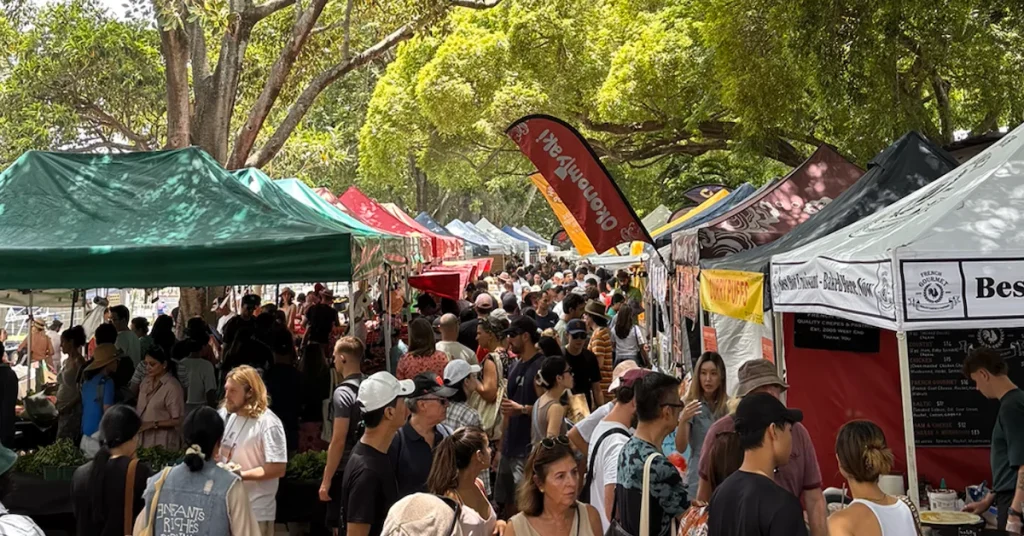
A new study from the University of Queensland’s St Lucia campus suggests that West End’s vibrant street markets, known for their colour and community feel, are being held back by rules that limit their full potential to serve Brisbane’s public life.
A Street Full of Promise
On Boundary Street, weekend markets fill the air with music, laughter and the scent of street food. Stalls selling vintage clothing, handmade soaps and second-hand books line the footpaths. Locals and visitors pause, chat, and linger, creating a rare moment where the street becomes a place to stay, not just walk through.
But it doesn’t last. The markets pack up early. The footpath clears amnd the energy that makes West End feel so alive fades until the next event.
That short burst of vibrancy — and how quickly it disappears — is exactly what caught the attention of urban planners at UQ St Lucia.

What the Research Uncovered
The team, led by Dr Dorina Pojani, looked at how market activity in West End and the CBD’s Suitcase Rummage compared to daily street vending in Nagpur, India. In both places, the researchers mapped how people responded to stalls through the five senses: sight, sound, smell, touch and movement.
Their findings were clear: even temporary stalls had a strong effect on how people interacted with public space. In West End, vendors slowed foot traffic and encouraged conversation. Market activity made people feel more at ease and more connected, but it vanished too soon.
Meanwhile, in Nagpur, street vending is an integral part of daily life. The scene is noisier and more crowded, but also more consistent. People often return to the same vendors repeatedly. The relationships are familiar and routine. The markets never really “end.”
Rules That Set Limits
Brisbane has rules in place to keep street activity controlled, and for good reason. Permits help manage footpath congestion, safety and hygiene. However, the UQ researchers argue that the balance has tipped too far.
Currently, Brisbane limits when, where and how long vendors can operate. Many stalls only appear during set events. They’re packed down before evening, even in neighbourhoods like West End, where the community clearly supports them.
Dr Pojani’s team argues that if Brisbane allowed more flexibility — longer trading hours, more frequent market days, and a wider variety of permitted spaces — neighbourhoods like West End could become even more welcoming and active, not just on weekends, but every day.
Streets That Invite Everyone
The research didn’t just look at vendors. It also paid close attention to who used the space. In West End, the researchers saw people of all ages and backgrounds engaging with markets: children, older adults, people in wheelchairs, and parents with prams.
This inclusiveness stood in contrast to the Nagpur sites, where crowded walkways made it harder for people with mobility needs to participate.
The team believes that good street design — wider footpaths, more shade, seating, and greenery — can support both accessibility and vibrancy. And West End already has many of these features. With fewer restrictions, it could be a model for the rest of the city.
A Community-First Future
Street vendors aren’t just selling things; they’re part of the social glue that brings people together. West End already shows how markets can boost the mood of a place and support local connections.
The UQ researchers say Brisbane has an opportunity to do more. Instead of limiting street vendors to rare events, the city could treat them as part of daily life, helping neighbourhoods like West End grow their identity, safety and street culture.
It’s not about turning the city upside down. It’s about giving the places that already work, like West End, more space to breathe.
Published 28-July-2025